Interactive TCCC Guidelines
& Military Trauma Equipment Playbook
The authoritative operational field guide bridging CoTCCC life-saving algorithms (CUF, TFC MARCH PAWS, TACEVAC) with military-grade hemostatic and thoracic trauma manufacturing specifications. Designed for defense procurement officers, tactical medics, and military IFAK contractors.
Care Under Fire / Threat
Immediate medical actions rendered while casualty and rescuer are under active hostile fire or direct imminent threat.
Suppress Hostile Threat & Return Fire
Responders must suppress the threat before attempting medical care. A casualty who can fight should continue to return fire.
- ✓Direct the casualty to return fire, move to cover, and apply self-aid if capable.
- ✓Do not enter the kill zone until effective fire superiority is established.
- ✓Keep the casualty from sustaining additional wounds by moving to ballistic cover.
- • Do NOT attempt airway intervention or wound packing under active direct fire.
- • Airway management is deferred until Tactical Field Care.
Immediate Limb Tourniquet Application
Apply a CoTCCC-recommended limb tourniquet immediately for life-threatening extremity bleeding, placed 'high and tight' over clothing.
- ✓Place the tourniquet over the uniform, high and tight on the affected limb.
- ✓Tighten until the distal arterial pulse is eliminated and bleeding completely ceases.
- ✓Secure the windlass rod into the clip and do not conceal the tourniquet under clothing.
- • Tourniquet failure is often due to insufficient tightness. If bleeding continues, apply a second tourniquet side-by-side proximal to the first.
Tactical Field Care (MARCH PAWS)
Comprehensive trauma care rendered once the casualty and unit are no longer under effective hostile fire.
M — Massive Hemorrhage: Wound Packing & Hemostatic Dressings
Reassess previous tourniquets. For non-extremity compressible junctional hemorrhage (groin, axilla, neck), pack wound tightly with hemostatic Z-fold gauze and hold continuous manual pressure for at least 3 minutes.
- ✓Clear cavity pooling blood and identify the precise actively bleeding arterial jet.
- ✓Pack accordion Z-fold hemostatic gauze directly against the bleeding vessel bone backing.
- ✓Maintain continuous perpendicular direct pressure for a minimum of 3 full minutes.
- ✓Apply a compression pressure bandage to maintain continuous radial tension.
- • Never use non-hemostatic regular cotton gauze for high-pressure arterial junctional wounds unless hemostatics are unavailable.
- • Do NOT remove packed hemostatic gauze if bleeding continues; apply a second pack on top and re-apply direct pressure.
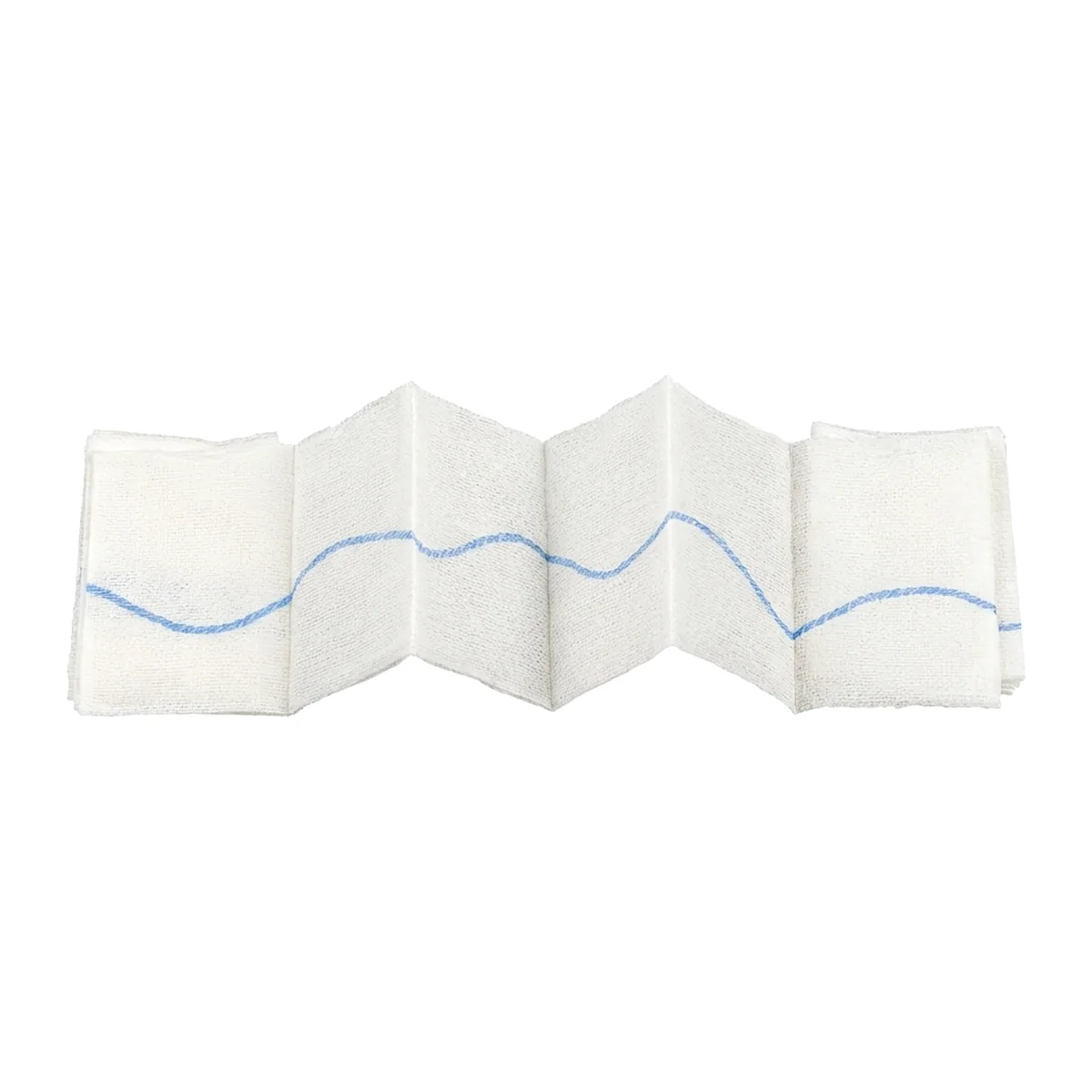
EarthShield Kaolin Z-Fold Gauze (RT-KAO-7537-G)
Inert Kaolin mineral triggers Factor XII contact coagulation cascade. Strictly 0°C exotherm (zero tissue burn), 5-year military shelf life, full-length X-ray barium sulfate tracer.
A — Airway: Conscious Positioning & Nasopharyngeal Airway (NPA)
Allow a conscious casualty to assume any comfortable breathing posture. For unconscious casualties with spontaneous breathing, insert a well-lubricated Nasopharyngeal Airway (NPA) and place in recovery position.
- ✓Inspect oral cavity for dislodged teeth, blood clots, or foreign debris.
- ✓Insert NPA perpendicular to the face following natural anatomical curvature.
- ✓If severe maxillofacial trauma obstructs airway, prepare for surgical cricothyroidotomy.
R — Respiration: Sucking Chest Wounds & Vented Chest Seal Protocol
All open, penetrating, and/or sucking chest wounds must be treated immediately by applying a CoTCCC-recommended vented chest seal. If a vented seal is unavailable, apply a non-vented seal and monitor closely for tension pneumothorax.
- ✓Wipe away excess blood, sweat, and debris around the chest wound using the included gauze pad.
- ✓Apply the vented chest seal centered directly over the wound during maximum casualty expiration.
- ✓Roll casualty to log-roll position and inspect the posterior torso for exit wounds; seal every entrance and exit defect.
- ✓If casualty develops progressive dyspnea, cyanosis, hypotension, or absent breath sounds: 'burp' the seal by pulling the tab to vent intra-pleural trapped air.
- • Failure to treat an exit wound is a frequent cause of fatal tension pneumothorax.
- • A standard occlusive dressing without vents can trap pressurized air and convert an open pneumothorax into a lethal tension pneumothorax.
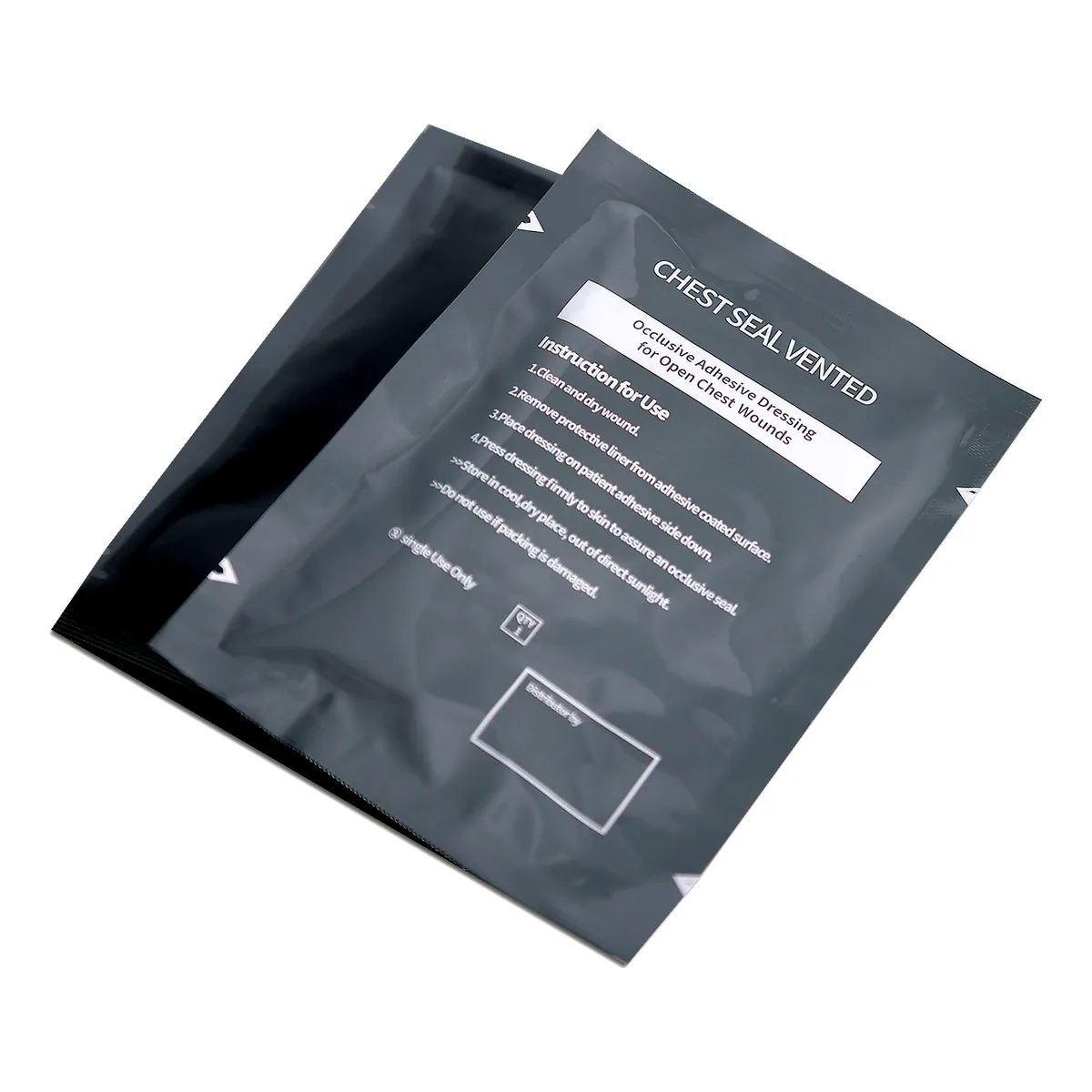
Tactical 3-Channel Vented Chest Seal Twin Pack (RT-CS-15-V3)
Three independent laminar flow relief channels. Medical-grade high-adhesion hydrogel operational from -78°C to +60°C. Sterile twin-pack for entry and exit wounds with oversized burping tabs.
C — Circulation: Pelvic Stabilization, Vascular Access & Whole Blood
Assess for hemorrhagic shock (altered mental status + absent radial pulse). Apply pelvic binder for suspected pelvic fracture. Obtain IV/IO access, administer Tranexamic Acid (TXA 2g IV/IO within 3 hours), and resuscitate with cold-stored low-titer O whole blood.
- ✓Re-assess all applied tourniquets and convert extremity tourniquets to pressure dressings if tactical evacuation is delayed >2 hours and bleeding is controlled.
- ✓Administer TXA 2g slow IV push as soon as possible after severe traumatic hemorrhage (must be within 3 hours of injury).
- ✓Titrate whole blood or blood components to maintain palpable radial pulse or systolic BP 80-90 mmHg.
H — Hypothermia Prevention & Head Trauma
Prevent hypothermia aggressively from the point of injury: remove wet uniform, insulate with active heating blanket and thermal barrier wrap. For head trauma, prevent hypoxia and hypotension.
- ✓Hypothermia can develop even in warm climates (>30°C) due to massive hemorrhagic volume loss.
- ✓Coagulation enzyme activity drops by ~10% for every 1°C decrease in core body temperature.
- ✓When casualty is hypothermic (<32°C), Factor XII dependent Kaolin efficiency decreases; factor-independent Chitosan dressings must be prioritized for deep junctional packing.
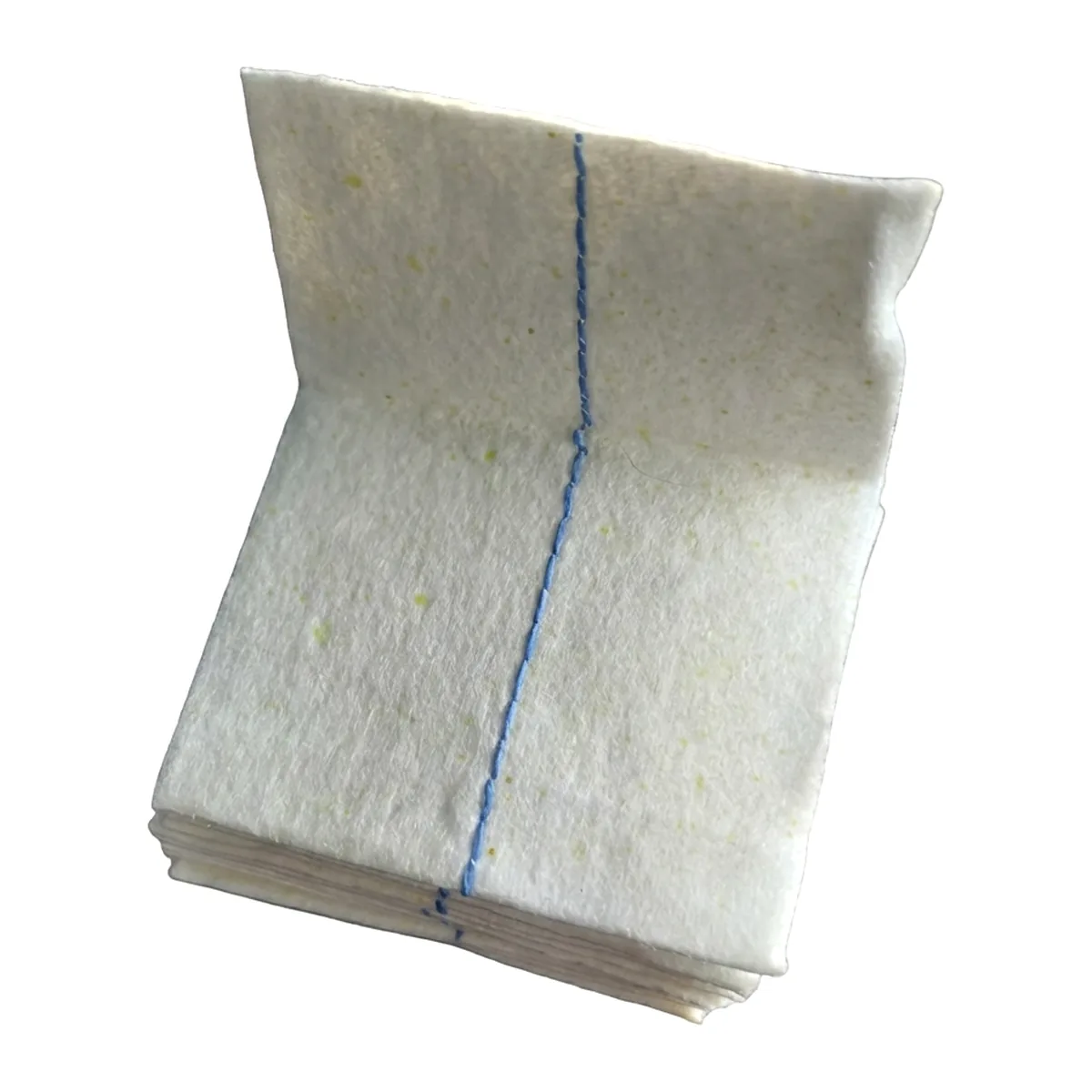
BioShield Chitosan Z-Fold Gauze (RT-CEL-7515)
High deacetylation degree (>=90%) marine-derived chitosan fleece. Polycationic red blood cell agglutination completely independent of human clotting factors. Fully effective in hypothermic (<32°C) or heparinized blood.
Tactical Evacuation Care (TACEVAC)
Care rendered en-route via aircraft, armored ground ambulance, or naval vessel during transit to definitive surgical facilities.
Altitude Pneumothorax Monitoring & Chest Seal Venting
As cabin pressure decreases with flight altitude, gas volumes expand according to Boyle's law. Casualties with sealed chest trauma must be closely watched for recurring tension pneumothorax.
- ✓Verify all one-way laminar valves on the chest seal remain free of dried encrusted blood.
- ✓If casualty deteriorates during ascent, immediately vent the seal ('burp') by peeling tab, or perform finger thoracostomy / needle decompression.
- ✓Ensure packaging materials and dressings are secured against rotor downwash.
TCCC Casualty Card (DD Form 1380) Handover
Record all clinical interventions, tourniquet application times, TXA doses, blood volumes, and vital signs on the waterproof TCCC Casualty Card affixed visibly to the casualty's outer gear.
- ✓Mark all tourniquet locations clearly on forehead/forearm ('T=HH:MM').
- ✓List specific hemostatics used (e.g. Kaolin Z-Fold / Chitosan) so surgical debridement teams can anticipate removal protocol.
- ✓Document chest seal application and any needle decompression attempts.
TCCC Injury Scenario & Mil-Spec Tender Matcher
TCCC Guidelines mandate: Pack wound cavity tightly with CoTCCC-recommended hemostatic Z-fold gauze directly to bleeding vessel, followed by continuous perpendicular pressure for >=3 minutes.
- ▪Zero Exotherm (0°C heat rise — no tissue burn risk)
- ▪Pharmaceutical-grade Kaolin triggers Factor XII coagulation cascade
- ▪Continuous Barium Sulfate (BaSO4) X-ray radiopaque tracer line
- ▪5-Year Validated Military Shelf Life in 4-layer aluminum pouch
Defense procurement officers and tactical buyers can copy this standardized specification directly into RFP (Request for Proposal) tender documents.
TECHNICAL SPECIFICATION CLAUSE: JUNCTIONAL HEMOSTATIC GAUZE
1. SIZING & FORMAT: Continuous accordion Z-folded format, 7.5 cm ± 0.3 cm width by 3.7 m ± 0.1 m length. Coreless ribbon for rapid single-handed dispensing directly into wound cavity.
2. CHEMICAL PROFILE: Pharmaceutical-grade inert Kaolin uniformly impregnated on high-density spunlace non-woven fleece. 100% zero thermal exotherm (0°C heat generation during clotting activation).
3. CLINICAL ACTION: Factor XII contact activation; achieves complete hemostasis in swine femoral arterial transection within 3 minutes of direct pressure. Wet tensile strength >= 15N with zero fiber shredding.
4. RADIOPACITY: Continuous embedded barium sulfate (BaSO4 >= 45%) tracer line detectable across full length under surgical fluoroscopy.
5. PACKAGING: Heavy-duty 4-layer aluminum barrier foil vacuum pouch; waterproof and tear notches on all 4 corners. 5-year validated shelf life under ambient military field conditions (-40°C to +65°C). Certified ISO 13485:2016 and CE/FDA registered manufacturing.
Published Trauma Hemostasis & Thoracic Research Citations
Clinical protocols and equipment specifications cited in this playbook are validated by published battlefield trauma studies in the Journal of Trauma, Military Medicine, and Prehospital Emergency Care.
Study Conclusion:Demonstrated that Kaolin-impregnated Z-fold gauze achieved 100% initial hemostasis in swine femoral transection with zero thermal tissue damage, establishing the scientific foundation for modern CoTCCC wound packing.
Study Conclusion:Proved that multi-channel vented chest seals prevent tension pneumothorax significantly better than non-vented occlusive seals by continuously venting pressurized pleural air without hydrogel failure under hemothorax.
Study Conclusion:Documented the reduction of preventable combat death from 24% to 9% following the systematic implementation of limb tourniquets, hemostatic gauze, and vented chest seals under the MARCH protocol.
Study Conclusion:Verified that polycationic chitosan dressings aggregate erythrocytes independently of functional clotting enzymes, maintaining rapid clot stability in blood cooled below 32°C.
Frequently Asked TCCC & Hemostasis Questions
Equipping Tactical Forces Worldwide with CoTCCC-Compliant Hemostatics
Operating from a 6,000 m² ISO Class 8 cleanroom with an annual capacity of 30,000,000 units. We provide military IFAK contractors and defense procurement entities with custom four-layer barrier foil packaging, multilingual instructions for use (IFU), and comprehensive regulatory dossiers.