Chest seals: close the wound, leave a vent path
Square / round · Vented / non-vented · 15 cm standard
A chest seal closes a penetrating chest wound at the point of injury and limits air entry into the pleural space. Vented models add a one-way path so trapped air has an exit. Four configurations, made alongside the three hemostasis lines, so both IFAK categories can sit on one quotation.
- Free sample evaluation
- Reply within 24 hours
- Four configurations available
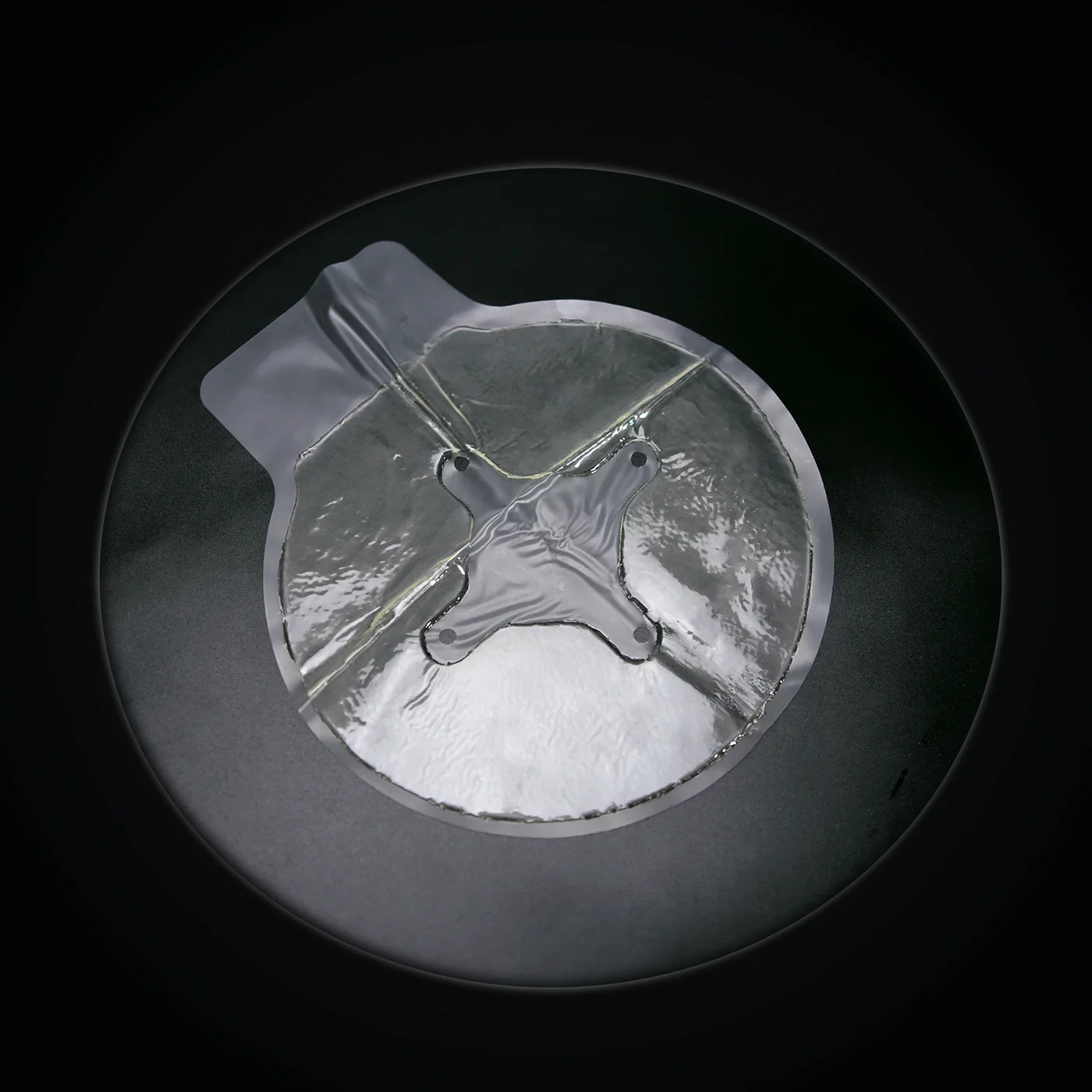
- Configurations, square and round
- 4
- Standard dressing size
- 15 × 15 cm
- Adhesion window (internal bench)
- −78–60 °C
- Shelf life
- 3 yr
Four features you can check against the sample
Each of these can be verified with the physical sample and the test reports, not taken on trust. We recommend checking all four during evaluation.
Strong adhesion
Tuned for austere environments: adheres and seals reliably over sweat, body hair and blood contamination.
Extreme temperature
No freezing at −78 °C and no softening or deformation at 60 °C; adhesion stays stable across the range.
Y / vortex one-way vent
Vents intrapleural air and wound exudate, then closes automatically under negative pressure to stop air re-entering, reducing tension pneumothorax risk.
Absorbs and keeps moist
Hydrocolloid absorbs exudate to form a gel, maintaining a moist wound environment and reducing adhesion and trauma on removal.
Internal bench records
Performance evidenceThe figures below come from factory bench testing for technical review. They are not third-party certification. Method, sample size and raw records are available on request; confirm the report covers the configuration you order.
Adhesion (porcine skin)
4.34 N/cm
Internal peel test; substrate and speed in the report
Temperature window
−78 °C to 60 °C
One hour at each endpoint; no significant loss of adhesion
Re-application
Can be lifted and reapplied
Per current instructions for use
Elongation at break
≈150%
Internal tensile test
Internal bench results only; not equivalent to third-party testing or clinical conclusions. Batch, substrate and technique will vary results.
What it seals — and what it does not
A chest seal is an occlusive dressing, not a hemostatic agent. Setting the boundary here keeps training and issue decisions aligned.
Seals an open chest wound
Covers a penetrating chest-wall wound and limits air entry into the pleural space.
Does not replace hemostatic material
Where active bleeding is also present, control bleeding first per the provider's protocol, then seal.
Does not replace decompression
If tension pneumothorax develops, decompress per protocol. The seal provides occlusion and a vent path only.
Not for superficial abrasions
Non-vented models are for wounds requiring full occlusion; ordinary dressings suit superficial wounds.
Indications, contraindications and procedure are governed by the instructions for use and the provider's medical protocol.
When a chest seal fails, check the adhesive first
When a chest seal fails in the field, check the adhesive first. Heat softens it, cold reduces initial tack, and sweat, blood, hair or dust keep the dressing from making full contact. A vent clogged by clot fails the same way. These are the questions worth asking before a tender.
Heat
A softened adhesive allows migration. Vehicles, tents and summer warehouses are all heat-exposure scenarios.
Cold
Low temperature reduces initial tack; application needs longer, firmer pressure. Validate cold-chain stock separately.
Moisture and contamination
Sweat, blood, hair and dust reduce contact area. Wiping the site and pressing firmly matter as much as the adhesive.
Vent obstruction
Clot or debris in the vent defeats one-way venting. Multi-channel designs keep a redundant path.
How to check a sample
- 01Hold at 37 °C and −78 °C for one hour each, apply to the forearm for ten minutes, then check the edges for lift.
- 02Apply once to sweaty skin and once to hair-bearing skin; record press time and edge contact.
- 03Immerse the vent in saline, press the film gently and observe one-way flow and backflow resistance.
- 04Check that sterilisation method, lot, manufacture date and expiry are legible on the pouch.
Protocol first, configuration second
Vented and non-vented are two practice choices, not old and new versions. The provider's training standard and medical protocol decide which is carried; procurement then chooses the configuration by wound pattern, kit space and pairing.
Vented (square Y / round vortex)
- For penetrating chest wounds where trapped air needs an escape path
- Channels close under negative pressure, limiting backflow of outside air
- Multi-channel design keeps a vent path if one channel is obstructed
Best as the lead SKU for prehospital, tactical and IFAK programs
Non-vented (square / round)
- For protocols that call for a fully occlusive patch
- Often the second patch in a bilateral or entry/exit pair
- Simple geometry fits compact kits
Best paired with a vented model
Four configurations, two footprints
Uniform 15 × 15 cm standard size across square and round footprints. Vented models add a one-way channel to the same occlusive layer. All four share one hydrocolloid adhesive system and foil vacuum packaging.

Square · Non-vented
- Size
- 15 × 15 cm
- Vent
- No vent channel
Wounds requiring full occlusion; second patch in a pair

Square · Y-vented
- Size
- 15 × 15 cm
- Vent
- Y-shaped one-way channel
Penetrating chest wounds needing venting; lead SKU

Round · Non-vented
- Size
- 15 × 15 cm
- Vent
- No vent channel
Round wounds; second patch in a pair

Round · Vortex-vented
- Size
- 15 × 15 cm
- Vent
- Vortex multi-channel one-way vent
Wounds needing venting; curved and bony surfaces
Official configuration schematics show the 15 × 15 cm standard footprint, pull tab, and one-way exhaust pathways.
Four configurations · shared specification
← Scroll horizontally →
| Parameter | Square · Non-vented | Square · Y-vented | Round · Non-vented | Round · Vortex |
|---|---|---|---|---|
| Dimensions | 15 × 15 cm | 15 × 15 cm | 15 × 15 cm | 15 × 15 cm |
| Footprint / base | Square standard | Square standard | Round (Φ15 cm active base) | Round (Φ15 cm active base) |
| Venting | Full occlusion (no vent) | Y-channel one-way vent; closes under negative pressure | Full occlusion (no vent) | Vortex multi-channel one-way vent; redundant exhaust paths |
| Temperature window | −78 °C to +60 °C · internal bench result | |||
| Adhesive | Hydrophilic hydrocolloid composite · 4.34 N/cm peel on porcine skin (internal) · lift-and-reseat | |||
| Sterility & pack | Latex-free · ISO 10993 evaluation · irradiation sterilised · foil vacuum pouch · 3-year shelf life | |||
Sterilisation, pack format and part numbers are confirmed on the signed specification; private label and kit assembly available by project. Whether to vent, and when, belongs to the provider's protocol and training. This page describes construction, not clinical advice.
Four layers, top to wound
On vented models the one-way channel sits on top of the transparent backing and exhausts toward the edge. Below it, the hydrocolloid layer absorbs exudate and forms a gel over irregular surfaces; the release liner protects the adhesive until it is peeled away at application.
One-way vent channel (vented models)
Exhausts air toward the edge and closes under negative pressure to limit backflow.
Transparent backing film
Keeps the wound and exudate visible after application so the dressing can be centred.
Hydrocolloid adhesive
Absorbs light exudate to form a gel and conforms to skin and bony prominences.
Release liner
Protects the adhesive before use and releases without stretching the dressing.
The diagram describes construction; the delivered lot is the reference.
Product and packaging
Chest seals are irradiation sterilised, vacuum sealed in foil pouches and intended for single use. Latex-free; biocompatibility is evaluated under the applicable ISO 10993 series.
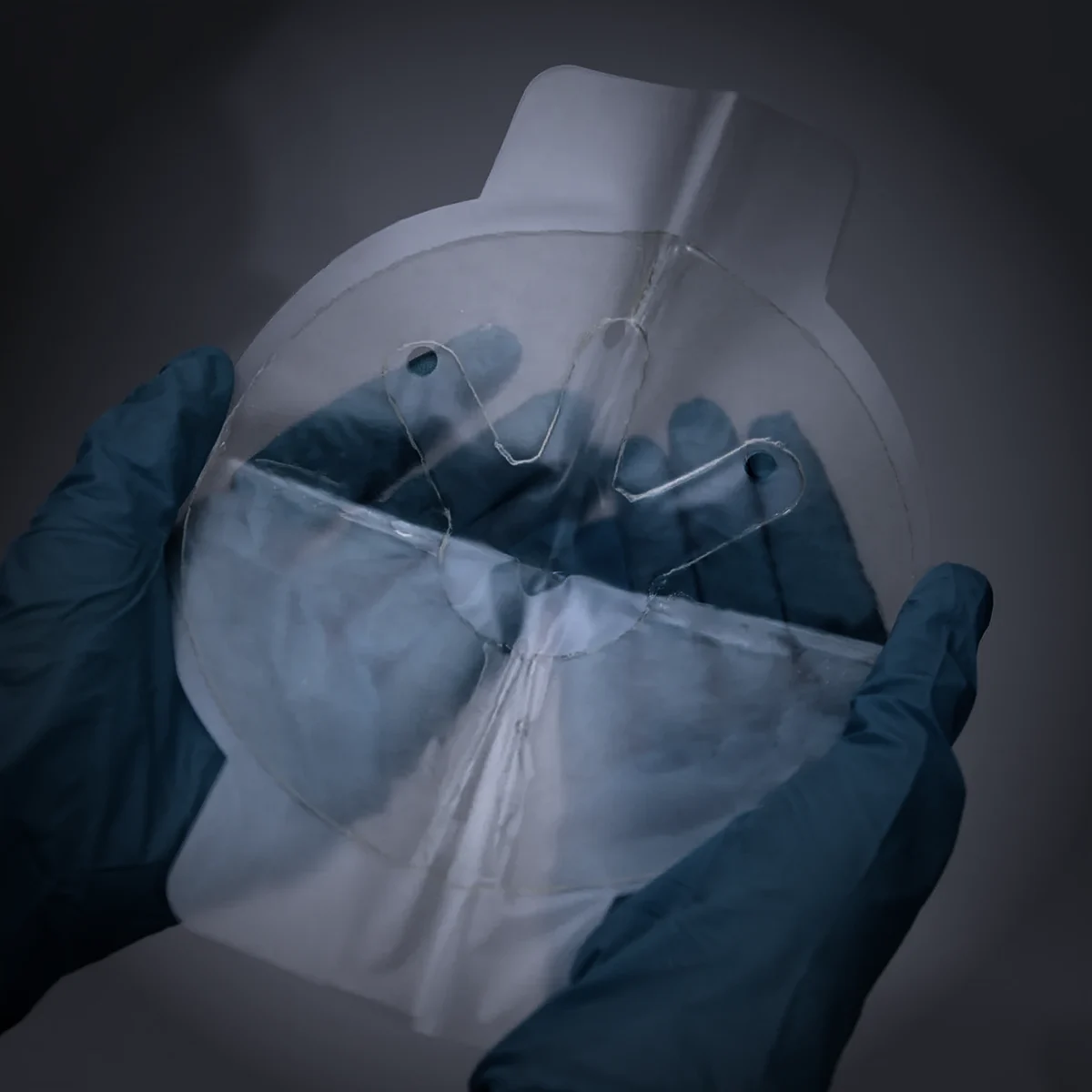
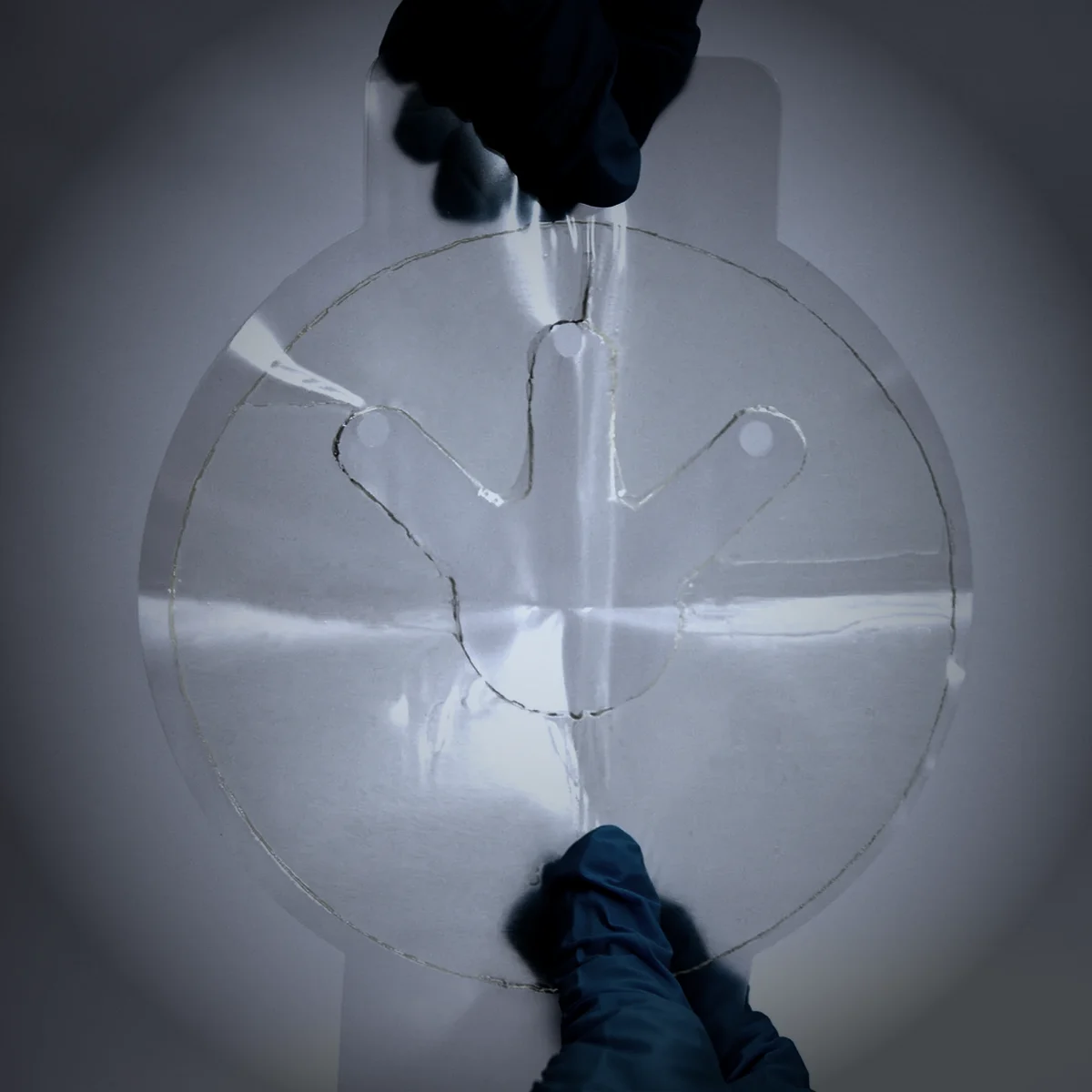
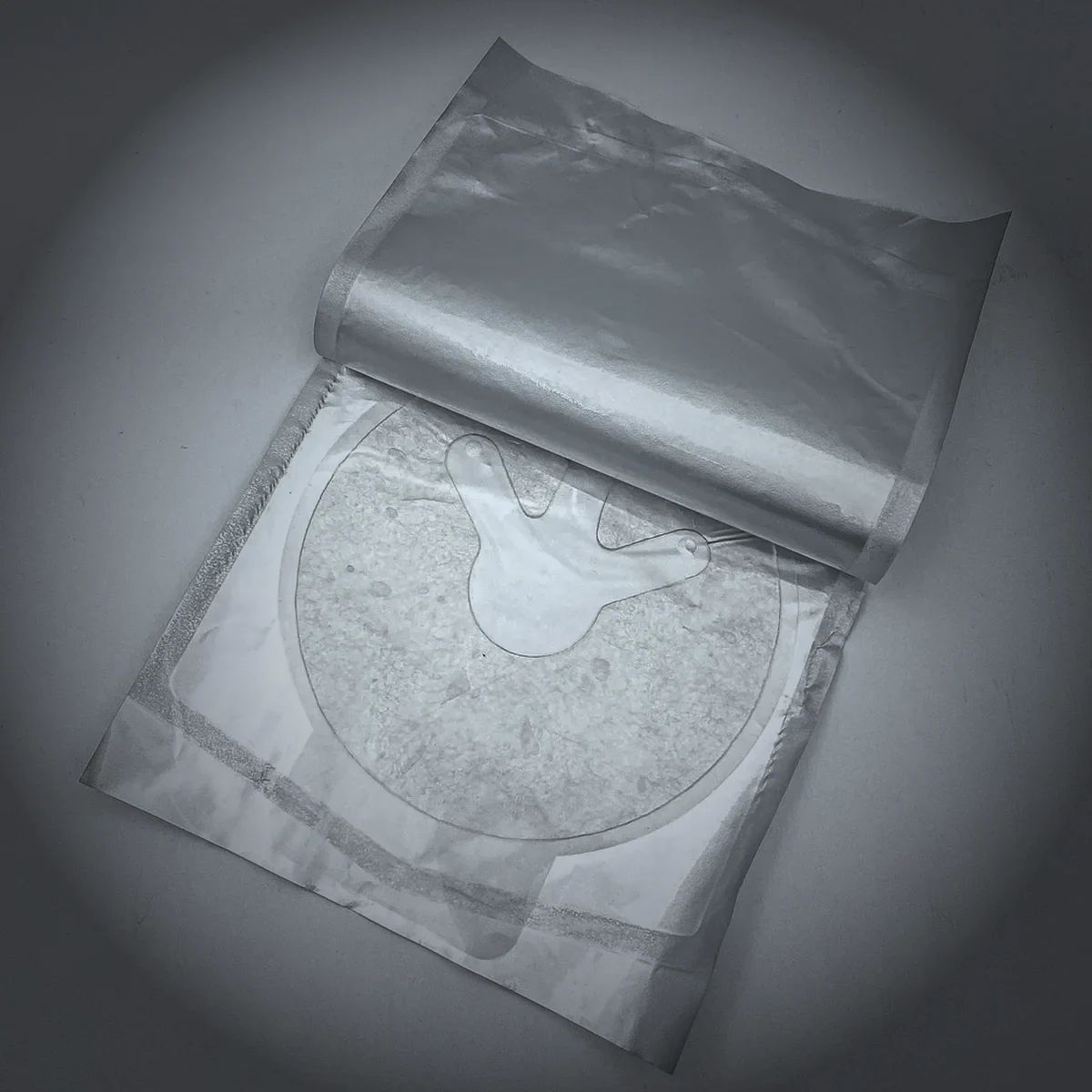
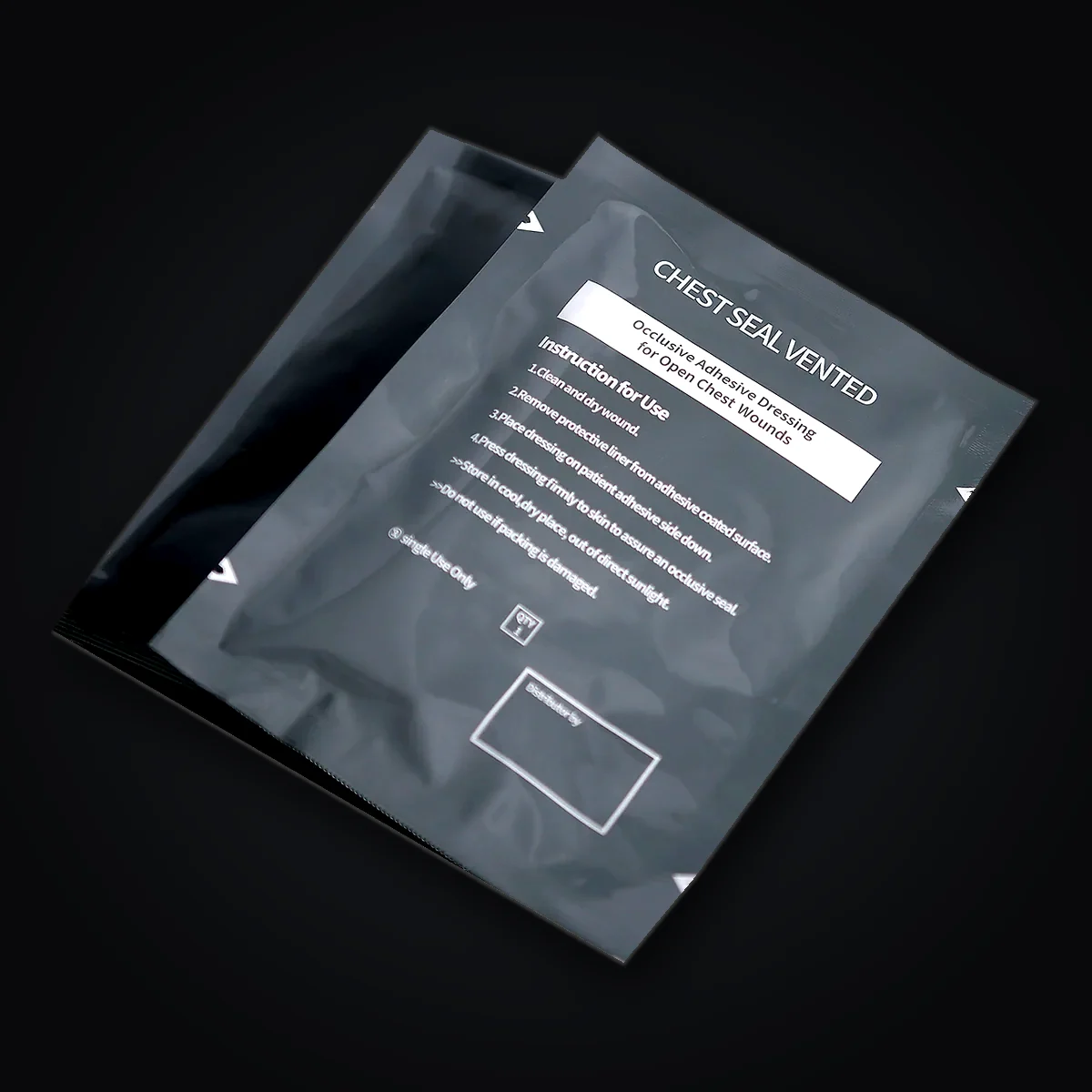
Photographs show construction and pack format only; the delivered lot follows the contract specification and lot number.
Sterile while the pouch is intact
Irradiation sterilisation
Sterilisation method and validation summary accompany the specification.
Foil vacuum pouch
Blocks moisture and light for long storage and sea freight.
Natural rubber latex-free
Reduces latex-allergy risk; material declarations on request.
Biocompatibility evaluation
Evaluated under applicable ISO 10993 series; reports on request.
Do not use if the pouch is damaged, the seal is compromised or the expiry date has passed.
From exposure to adhesion
A process outline for procurement and training discussions. Actual use follows the IFU and the provider's medical protocol.
- 01
Expose and inspect
Cut or move clothing aside and check the front, sides and axillae for additional penetrating wounds.
- 02
Prepare the site
Remove blood and fluid around the wound per protocol to reduce contamination that affects adhesion.
- 03
Centre and press
Peel the liner, centre the dressing over the wound and press from the centre outward until the edges are seated.
- 04
Check and monitor
Check the edges and vent path; treat a paired wound per protocol and keep monitoring breathing and the site.
Outline only; it does not replace the IFU, training or the provider's medical protocol.
Different buyers, different priorities
The same dressing enters different procurement lists for different reasons. Below are the usual concerns and a starting configuration; the provider's protocol decides the final choice.
Individual IFAK / personal kit
- Main concern
- Kit space, opening speed, paired dressing
- Starting configuration
- Square Y-vented paired with square non-vented
EMS and ambulance
- Main concern
- Resupply, batch documents, application steps
- Starting configuration
- Square Y-vented; round by kit space
Hospital and clinical departments
- Main concern
- Specification, batch traceability, sterile barrier
- Starting configuration
- Vented or non-vented per departmental protocol
Military and law enforcement
- Main concern
- IFAK fit, duty and training stock, combined ordering
- Starting configuration
- Quoted together with hemostasis lines
Wilderness and remote rescue
- Main concern
- Storage temperature, weight, long storage
- Starting configuration
- Round vented; foil pouch for carry
| Buyer | Main concern | Starting configuration |
|---|---|---|
| Individual IFAK / personal kit | Kit space, opening speed, paired dressing | Square Y-vented paired with square non-vented |
| EMS and ambulance | Resupply, batch documents, application steps | Square Y-vented; round by kit space |
| Hospital and clinical departments | Specification, batch traceability, sterile barrier | Vented or non-vented per departmental protocol |
| Military and law enforcement | IFAK fit, duty and training stock, combined ordering | Quoted together with hemostasis lines |
| Wilderness and remote rescue | Storage temperature, weight, long storage | Round vented; foil pouch for carry |
Configuration suggestions are not clinical advice; use and disposal follow the IFU and medical protocol.
Documents and batch records
A system certificate shows that a quality management system was audited. It does not replace the specification, release record and test report for this shipment. Five items, supplied on request within 24 hours of a configuration and market brief.
Quality system certificate
The certificate category within the ISO 13485 scope; scans on request.
Current product specification
Configuration, dimensions, materials, adhesive, vent design, packaging, shelf life and storage.
Per-lot release record
Ties the batch actually shipped to its dimensional, visual, packaging and release checks.
Adhesion and temperature reports
Method and results of the internal bench tests, for technical review.
Export document set
COA, commercial invoice, packing list, certificate of origin, plus SDS and HS-code support where applicable.
FDA establishment registration and device listing are not product clearance, authorisation or certification. The exact regulatory status is confirmed in writing.
Documents
Supplied per configuration and destination country. Electronic copies are sent within 24 hours of confirming the configuration.From configuration to shipment
Lock the configuration, pack, adhesive evidence, labelling and destination documents before scheduling production.
- 01
Send requirements
Configuration mix, quantity, target market, and whether private label is needed.
- 02
Specification and quote
Current datasheet, tiered pricing, MOQ and available documents.
- 03
Sample evaluation
Adhesive, film, vent, pouch and label checked one by one. Sampling takes 7–15 working days.
- 04
Production and release
Lot coding, assembly, sterile packing and release checks.
Frequently asked questions
No. It closes an open chest wound and, on vented models, provides a one-way vent path. It replaces neither hemostatic material nor chest decompression.
Sample first, then specify
All four configurations are available as samples; quoted together with the hemostasis lines, response within 24 hours.
- Four configurations
- Specification with quotation
- Response within 24 hours